Saturday, February 16, 2013

New Legislative Proposal: Fifty New Medical Schools For More And Better Doctors Act

I am proposing new legislation!

The Fifty New Medical Schools for More and Better Doctors Act,
also known as the  
American Medical Professional Education Reform Act (AMPERA)


  • OUR MEDICAL EDUCATION SYSTEM NEEDS TO BE REFORMED TO PROVIDE MORE AND BETTER DOCTOR
    • THIS WILL IMPROVE HEALTH CARE, EXPAND THE ECONOMY, AND HELP REDUCE HEALTH CARE COSTS
  • THE PROPOSED REFORM IS TO OPEN FIFTY NEW MEDICAL SCHOOLS, ONE IN EACH STATE,
    • AND REDUCE THE TOTAL TRAINING TIME BY STARTING MEDICAL EDUCATION EARLIER THIS WILL BE PAID FOR BY A FIFTY-BILLION DOLLAR GRANT, ONE BILLION FOR EACH SCHOOL, TO SET UP A NEW FACILITY AND SCHOLARSHIPS. 
  •   THE NECESSARY FUNDS WILL COME, NOT FROM TAXES, BUT FROM US CORPORATIONS’ OVERSEAS CASH DEPOSITS IN EXCHANGE FOR TAX BENEFITS
  • HEALTH CARE COSTS WILL BE REDUCED BY
    • STARTING TRAINING EARLIER, SHORTENING THE TOTAL EDUCATIONAL CYCLE
    • GRADUATING MORE NURSE PRACTITIONERS
    • INCREASING COMPETITION
BACKGROUND:
According to USA Today, a severe doctor shortage is growing worse, and has been predicted to reach up to 200,000 in a few years.
“The country needs to train 3,000 to 10,000 more physicians a year — up from the current 25,000 — to meet the growing medical needs of an aging, wealthy nation, the studies say. Because it takes 10 years to train a doctor, the nation will have a shortage of 85,000 to 200,000 doctors in 2020 unless action is taken soon.”  USA Today Article “Medical Miscalculation Creates Doctor Shortage”


“With a growing, aging population, the demand for physicians will intensify over the coming years.  According to AAMC estimates, the United States faces a shortage of more than 90,000 physicians by 2020—a number that will grow to more than 130,000 by 2025.”

We have a shortage of US Medical Schools.  Several states have no medical school whatsoever.
We do not have enough U.S. based medical schools to meet the demand for physicians.
We rely on approximately 25% foreign imports to staff our graduate medical programs.
  • According to the American Medical Association:
 “ In 2006, out of 902,053 physicians, 228,665 International Medical Graduates [IMGs] received medical degrees from 127 different countries, accounting for 25.3% of the total physician count.”  AMA Official Website
  • According to the American Medical Association, “International Medical Graduates [IMG’s] make up approximately 25% of the U.S. physician population.” AMA Official Website.

Medical education starts too late and takes too long.  In most foreign countries, medical education starts directly out of high school.

SOLUTION:
Congress passes the
The Fifty New Medical Schools for More and Better Doctors Act,
also known as the American Medical Professional Education Reform Act (AMPERA),

Elements of the Proposed Legislation:
  • Using the Land Grant College system as a model, Congress sponsors fifty new medical schools, one in each state.Each school is granted $1 billion to establish the facility, hire the faculty, and set up extensive scholarships.
States are encouraged to participate, buying the land and providing matching funds.
  • A small agency is set up to establish standards, accredit the schools, and establish a timetable to get them started.
  • $50 Billion Funding is provided as follows:
    • Donations to a trust fund by U.S. Corporation
      • Many US Corporations have multiple billions of dollars in cash, on deposit in foreign countries.  They don’t want to repatriate the funds because of the tax implications.
      • Establish a tax credit—for every billion dollars a corporation provides to the trust fund, it can repatriate ten billion dollars (or a minimum number to provide the necessary tax incentive) tax free
      • That avoids higher taxes
    • Second, and less preferable alternative would be Congressional Appropriation
  •  Educational times would be shortened, and each medical school would produce Doctors, Nurse Practitioners, and Registered Nurses, as follows:
    • Education starts after 2 years of college preparation.
    • Total time to MD Degree = 6 years
    • Total time to NP Degree = 5 years
    • Total time to RN Degree = 4 years
    • Liberal scholarships would be funded

Join me in urging Congress to pass this legislation.

Sunday, March 6, 2011

George Will Hits The Nail on the Head

I read this essay by George Will (courtesy of the Newsweek Magazine which Mom and Dad send us at work--thanks!)
Its called High Speed Insolvency--Why Liberals Love Trains

Why do we borrow BILLIONS of dollars to build trains to take us from Point A to Point B more slowly, and at higher cost, than airplanes, and that almost no one uses?
He thinks he has the answer.
What do you think?

There's another reason why we get high speed trains, that he doesn't touch on.
People always have, and always will, love to sell things to the government, whether we need them or not. Where there's money to be made, there will always be a lobby to urge the government to buy--even dumb stuff. As citizens, we need to be better consumers. Otherwise, a fool and his money are soon parted.
George Will's piece should be studied as a masterpiece of opinion essay writing--whether one agrees with conclusion or not.

Sunday, February 21, 2010

Who said the President associated with terrorists?

American civic discourse has always been a contact sport. Who wrote this, about whom, and when?


Mr. X said: "The democrats are divided into speculative theorists and absolute terrorists. With the latter I am not disposed to class Mr. Y."


Answers below.

Mr. X was the Chief Justice of the Supreme Court, John Marshall.

Mr. Y was Thomas Jefferson, the president elect of the United States.

Marshall wrote this in a letter on the same day in March 1801 that he administered the oath of office to Thomas Jefferson.
Source: Jeffrey Rosen, The Supreme Court (Times Books 2007), p. 27.

And I thought that the terrorists had only been around since 9/11.

Sunday, October 25, 2009

The Glorification of Mediocrity

What's wrong with this picture?
Mediocrity is praised.
Casual becomes slovenly.
Accomplishment is to be avoided.
Slackers rule, no really.

Wednesday, April 29, 2009

What Is The Most Important Character Trait?

Self-Discipline.
Without it, one cannot do the right thing.
It does little good to know what is right if one does not choose the right.

What do you think?

Tuesday, March 24, 2009

The Path from Liberty to Social Justice

When our country was founded, the primary emphasis was on the establishment of liberty--freedom from oppression by government. Thus, our constitution is one of limited powers; all powers not conferred on government in the constitution are reserved to the people.


Our national experiment in establishing liberty has been successful. Freedom has been passed down from generation to generation, for more than 225 years. This is a miracle.

We now take freedom somewhat for granted. The national government of limited powers has been instrumental in protecting our freedom from threats, foreign and domestic, to the point where government is now viewed as a source of freedom, not a source of tyranny.

Two points follow.
  • First, with our basic freedoms secured, most Americans now want the next logical step: social justice. With liberty as our birthright, people are now able to focus achieving the happiness which we are free to pursue. Equality of opportunity is fine as far as it goes; equality of outcome is even better.
  • Second, the government is widely perceived as a common resource to help us achieve this goal. We have forgotten that government was a source of tyranny; we now invoke its assistance in achieving social justice.
We see this trend unleashed in the political will that elected the current administration.
The best path to social justice should be the subject of a vigorous debate.


Saturday, March 7, 2009

Economics and Freedom

Here's an interesting website devoted to economics and freedom. The Mises Institute says:

"Everyone carries a part of society on his shoulders," wrote Ludwig von Mises, "no one is relieved of his share of responsibility by others. And no one can find a safe way for himself if society is sweeping towards destruction. Therefore everyone, in his own interest, must thrust himself vigorously into the intellectual battle."

"It is the mission of the Mises Institute to restore a high place for theory in economics and the social sciences, encourage a revival of critical historical research, and draw attention to neglected traditions in Western philosophy. In this cause, the Mises Institute works to advance the Austrian School of economics and the Misesian tradition, and, in application, defends the market economy, private property, sound money, and peaceful international relations, while opposing government intervention as economically and socially destructive."

Tuesday, March 3, 2009

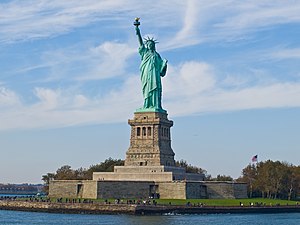
The Statue of Responsibility


Victor Frankl makes an interesting suggestion in his classic book Man's Search for Meaning. As a counterbalance to the Statute of Liberty on the East Coast, we should have a "Statue of Responsibility" on the West Coast.
Every right is balanced by a duty, and every liberty balanced by a responsibility. If every citizen took this seriously, think how much better our society would be.
And its not an idle dream. After I started this blog entry I discovered that there is an entire website devoted to this idea. Maybe it will happen--but only if we take responsibility for it.


Saturday, February 28, 2009

Who Benefits From The Stimulus Package?

A thoughtful reader asked this question.

The Stimulus package is supposed to create jobs. As enacted, it seems more likely to stimulate government. Growing government is like putting on weight: its easy to gain weight and hard to take it off. All the diets in the world don't work very well. And that will likely be the legacy of the stimulus: a drag on the economy just when natural market forces would otherwise rebound.

Sunday, February 1, 2009

Stimulus vs. Bloatulus

The proposed Stimulus Package is more of a Bloatulus package. Many commentators point out that it sets up long-term government spending on entitlements without short-term impetus to the economy.

We don't need more debt--we need less.

Why is it so important to pass a huge spending bill now, when much of the spending doesn't occur until later years?


As they said in 7th Grade Shop Class--"HASTE MAKES WASTE."

Sunday, January 25, 2009

Wanted: Heroes not Neros

Legend is that Nero fiddled while Rome burned.

In this Opinion Piece by Mickey Edwards, former Reagan Administration official, former Republican Congressman, and co-cofounder of Heritage Foundation, Mickey Edwards argues that Conservative Reaganism stands for effective limited government, not merely a "small government" that relies on the private sector for everything. Thanks to reader Sasquatch for bringing this to piece to our attention.

Edwards argues that conservatives "also have an obligation to propose alternative solutions. It is government's job -- Reagan again -- to provide opportunity and foster productivity. With the nation in financial collapse, nothing is more imprudent -- more antithetical to true conservatism -- than to do nothing."

  • The knock on the Republican Hoover administration is that it didn't do enough to respond to the Great Depression.
  • The knock on the Democratic Roosevelt administration is that its tax and spend policies lengthened and deepened the great depression.
If you're in a burning economic crises, you don't want to see your emperor fiddling on the violin while nature takes its course.

On the other hand, you don't want to see your emperor hiring legions of workers to build new palaces, just to keep people busy and money flowing.

We need an economic policy that satisfies political demand and makes economic sense.

Sunday, December 7, 2008

Conservatism's Fatal Flaw? Hitting the bottom hurts too much.

"Keep government out. Let the markets govern themselves. That is the way to growth and prosperity." This is the core of economic conservatism.

It sounds nice. But when the market is in a free fall, people don't want to wait for the crash when it hits bottom. It hurts too bad. So there is an incentive to aid the market. It has been that way since the 1930's.

When the depression of 1929 started, the conservative/Republican Hoover administration largely market forces continue. With skyrocketing unemployment and no safety net, the social costs were high. People did not want to pay the costs--Republicans were voted out and the Democratic era of government intervention to aid the economy, and the little guy, was introduced.

The Reagan Revolution convinced many people that free markets were the best path to renewed prosperity. But now we see that an unregulated (or misregulated) market led to a huge crash.

Alan Greenspan admitted his mistake-assuming that the markets could self-regulate.

Now the prevailing sentiment is: government intervention is needed to prevent a worse crash.

If you accept that some intervention is needed, the only issue is how much. Conservatism's central tenet--let market forces rule, free from government intervention--turns out to be (as Captain Barbossa famously said in Pirates of the Caribbean) "more of a guideline" than an "actual rule."

So conservatives and liberals agree on the fundamental principle: some government intervention is necessary and appropriate. The only question is: How Much?

Thursday, November 6, 2008

The Parable of the Two Drivers--President-Elect Obama Gets Behind the Steering Wheel

Once upon a time a family went on vacation. They decided to spend the week at Prosperityland Resort. They were exited and piled into the family minivan. Dad took driver’s seat and Mom got shotgun. The kids sat in the back rows—all of them, and there were a lot of kids.

Unfortunately, Mom and Dad couldn’t agree on the best way to get ProsperityLand—Mom wanted to take the Interstate and Dad thought the scenic route would be better. They also couldn’t agree who would drive. They compromised. Mom and Dad each put a hand on the steering wheel. Mom put her foot on the brake, and Dad put his foot on the gas. Off they went!

You can guess what happened. Every time Mom pulled the car to the right, Dad jerked it back to the left. When Dad accelerated, Mom put on the brakes to keep him from going too fast—especially if he was steering the car the wrong way. The car lurched left, rocked right, spun out and skidded to a stop, again and again and again. Every time the family thought they were making progress, Mom would tell Dad that they had made a wrong turn, and should go back—or vice versa.

The kids took the brunt of it; they got car sick; they tired of wasting their vacation time driving when they should have been at ProsperityLand. So they got together and said “STOP.”

“Mom—you stay on the passenger side. Let Dad drive alone for a while. Don’t touch the steering wheel and don’t touch the brakes. You can give Dad advice, but he doesn’t have to take it if he doesn’t want to. We’ll let Dad drive for four hours—and if he can’t get us to ProsperityLand his way, we’ll let you take a turn, Mom.” Mom wasn’t happy about it but she didn’t really have a choice.

Off they went again… This time the driving was smoother. The kids could enjoy the scenery out the window without getting car sick. They could only hope, ProsperityLand was around the corner…

This parable is one reason to be glad for the decisive national election results. President Elect Obama will have the steering wheel and the Democrats will be driving. For the last 4-8 years, the Democrats and Republicans have been pulling the steering wheel back and forth. We certainly have not been in Prosperityland—maybe we were going in the wrong direction, or maybe we just missed the exit. But with one party steering the country for a while, perhaps we’ll get to ProsperityLand a little faster; and if we don’t, the kids will give Mom a turn.

Sunday, October 26, 2008

The Messenger Is More Important Than The Message


I expect a strong victory by Barrack Obama in the upcoming presidential election.

There are parallels to the Reagan Revolution in 1980. In that election, Reagan demonstrated his skills as the "great communicator." He popularized conservatism by communicating his message of smaller government and less regulation. Reagan did it when the country was in an economic and political malaise, dissatisfied with the Carter administration. Reagan didn't bend his views to the popular will. Instead, he bent the public will to his views. Result: the country elected him, embracing conservative theories that hadn't been strongly advocated since the Goldwater era.

We're seeing the same phenomenon now. By the strength of his political charisma and communication skills, Obama is connecting with the middle range of the political spectrum. He is re-popularizing the traditional democratic liberal ideals of social improvement through governmental programs. He is bringing back a message that lost steam after the Johnson administration. Obama's programs are branded by Republicans as "tax and spend." But the messenger is so good that he can bring people around to his view.

These are hallmarks of major political figures: using the force of their communication skills to align public opinion with their policies. In this way, the Messenger is more important than the Message. Without the right Messenger, the Message is lost.

Sunday, October 12, 2008

Paul Revere's Ride--in 2008

In Boston recently, I stopped in front of the statute commemorating Paul Revere. I got to thinking, if Paul Revere were alive today, what would he warn us about?
  • The Terrorists are coming! The Terrorists are coming!
  • The Credit Crisis is coming! The Credit Crisis is coming!
  • The election is coming! The election is coming!
Things are much clearer in hindsight. The dangers facing us today seem diffuse and different. The best way to move ahead in an uncertain world is to to identify the most important priorities and follow those. And if you can find your own Paul Revere--someone who shares your priorities and is on the lookout for problems--follow Mr. Revere's advice.